




Why Most Teams Miss the Buying Signals Already in Their CRM
Published:


Most revenue teams are not losing deals because they lack data. They're losing them because the signals they already have, engagement drops, stalled stages, pricing page visits, hiring spikes, never trigger a coordinated response.
Detection is not the problem. The gap between signal and action is.
If you're a CRO, VP of Sales, or RevOps leader, you already know what buying signals are. What you need is a rigorous framework for operationalizing them: which signals matter most, how to layer them for context, and how to convert detection into consistent seller action. That's exactly what follows.
Key takeaways
- Detecting B2B buying signals without a system to act on them creates noise, not pipeline momentum.
- First-party signals from direct buyer interactions offer more reliable intent data than inferred third-party sources.
- Deal and pipeline signals, such as stalled stages, missing stakeholders, and declining engagement function as buying signals inside active opportunities.
- Layering behavioral, firmographic, and deal-level signals compounds predictive confidence before committing seller time.
- Automated action on prioritized signals, not just detection, is what improves forecast accuracy and win rates.
The great growth squeeze is real
The pressure on revenue teams is structural, not cyclical. Buyers have more information, more options, and higher expectations than at any point in the modern sales era. Sellers who wait for inbound intent or rely on gut instinct are consistently outpaced by teams that build systematic signal-detection programs.
Bigger committees, longer cycles, higher expectations
The average B2B buying group now includes approximately nine stakeholders, according to widely cited Gartner research on complex enterprise purchases. Each of those stakeholders generates signals: content interactions, role-specific objections, meeting attendance patterns, engagement with competitive content. More stakeholders means more signal sources. Teams with a detection-and-action system see this as a compounding advantage. Teams without one see it as noise.
Expectations compound the complexity. Today's B2B buyers have done extensive research before a rep ever reaches them, and they expect personalization to match. By the time a signal fires, the window for influence is already narrowing.
Why traditional prospecting is losing ground
Spray-and-pray prospecting carries a measurable cost. Low response rates burn rep capacity, generic messaging signals disinterest to buyers, and quota attainment suffers when the top of the funnel is volume-based rather than signal-driven. Forecast misses that feel random are often predictable in retrospect, just not to a team without a signal-detection system.
What most teams get wrong about signals
Here's the failure mode most revenue leaders don't name: their teams detect signals but have no defined protocol for what happens next. Signal detection becomes a reporting exercise rather than a revenue action.
Detection without action is just noise
Signal volume without prioritization creates cognitive overload for reps. When everything is a priority, nothing is. Tools like Highspot and ZoomInfo have raised the bar on signal classification and taxonomy. They define signals well and provide broad coverage, but classification is not action. A rep who sees 30 signals flagged in their workflow with no ranked response protocol will process none of them systematically. The competitive advantage belongs to the team whose platform converts ranked signals into the next best action automatically.
The gap between signal and seller response
Responsiveness to high-intent signals correlates highly with win rates. Data on win rate drivers confirms that speed-to-response on high-intent activity is among the strongest predictors of deal outcomes. Every hour between a signal firing and a rep acting is an hour the buyer spends evaluating a competitor.
Salesloft Rhythm is built specifically to close this gap. When a signal fires, from a first-party interaction, an intent data provider, or a deal-level change, Rhythm applies AI prioritization and surfaces the next best action directly in the seller's workflow. Not in a dashboard they have to log into separately. In the workflow where they already work.
The B2B buying signals that matter
Most signal frameworks stop at four or five categories. This one adds a sixth because deal-level signals inside active pipeline are often the most actionable and the most ignored.
Behavioral and intent signals
Behavioral signals are direct engagement events: pricing page visits, demo requests, content downloads, webinar attendance, repeat product page views. Intent signals are inferred research activity captured by third-party data providers — topic clusters, keyword surges, competitive content consumption. Both matter, but they serve different purposes. Behavioral signals confirm buyer interest in your solution. Intent signals surface buyers who haven't engaged yet but are actively in-market.
Example: An account visits your pricing page three times in five days. That's a behavioral signal. The same account is also flagged by your intent provider for research on "sales engagement platform comparison." Combined, those signals create a high-confidence, high-urgency prospecting trigger.
Firmographic and technographic signals
Firmographic signals are company-level changes: funding announcements, headcount growth in revenue-facing roles, executive hires, expansion into new markets.
Technographic signals cover stack shifts such as adopting a complementary tool, churning from a competitor, or adding a platform that creates a natural integration opportunity.
These signals often precede active engagement by weeks. They are early-pipeline triggers, not qualification criteria. When using account-based signals to target buying committees, firmographic and technographic data helps identify which accounts are most likely to have an active need before they raise their hand.
First-party signals
First-party signals are engagement data captured directly through your own channels: emails opened and replied to, calls completed, meetings booked, content consumed inside Salesloft workflows. Unlike third-party intent data, first-party signals are not inferred. They are tied to real buyer behavior at a specific moment in your pipeline.
This distinction matters for prioritization. First-party signals carry more context than probabilistic inference from external sources. A contact who replied to a discovery email, attended a demo, and clicked a pricing link in a follow-up cadence is sending a clearer signal than a firmographic match in an intent database. Turning buyer intent data into automated seller actions requires ingesting both, but first-party signals should anchor your prioritization model.
Pipeline Signals
This category doesn't exist in most signal frameworks, which is exactly why it represents a competitive advantage for teams that add it. Deal and pipeline signals are opportunity-level indicators inside active deals: stage stagnation past expected duration, missing next steps, declining stakeholder engagement scores, forecast category changes, and buying group gaps surfaced by Salesloft Deals.
A deal sitting in the same stage for three weeks past benchmark is a signal. A champion who stopped engaging two weeks before close is a signal. A forecast category that shifted from Commit to Pipeline without explanation is a signal. Salesloft Analytics surfaces these automatically so managers can intervene before they hit the number.
Why buying signals drive revenue outcomes
The case for signal-based selling is not just efficiency — it's buyer psychology. Research on sales timing and behavioral science shows that early responders to high-intent signals anchor the evaluation frame. Buyers who hear from a prepared seller at the moment of maximum interest are significantly more likely to enter an evaluation with that seller's criteria as the baseline.
Signals replace guesswork with buyer evidence
Signal-based prospecting activates buyers at the right moment rather than the most convenient moment for the seller. This directly improves pipeline quality: reps prioritize deals most likely to close, not the most recently created. Analytics that surface signal patterns from closed-won data make this prioritization increasingly accurate over time.
Building a signal-based program that works
A signal-based program is not a tool purchase. It's a defined system: which signals matter for your ICP, how they layer together, what response each tier requires, and how your platform automates the action layer. Here's the four-step framework.
Step 1: Define which signals match your ICP
Start with closed-won data. Identify which signal patterns were present in the 90 days before initial communication for deals that closed. Which accounts had visited pricing before the first touch? Which had a firmographic event in the prior quarter? Propensity scoring, assigning predictive weight to signals based on their correlation with conversion, turns this historical analysis into a forward-looking prioritization model.
Weight signals based on actual predictive power, not assumptions about what sounds important. For many enterprise B2B teams, first-party engagement signals outperform intent data as conversion predictors. Let your closed-won data confirm that rather than inheriting a framework designed for someone else's ICP.
Step 2: Layer signals for stronger context
Single signals are weak. Aligned signals across multiple categories compound confidence. A funding announcement (firmographic) plus repeated pricing page visits (behavioral) plus a new VP of Sales hire (firmographic) plus active engagement in a Salesloft cadence (first-party) creates a high-confidence account cluster that warrants immediate qualification.
Layering also reduces false positives. An account that spikes on intent but shows no first-party engagement and no firmographic trigger may not be in-market for your solution. Layering protects rep time from signals that look strong in isolation but don't hold up in context.
Step 3: Set response rules by signal tier
Define three tiers with predefined response protocols before reps see a single signal:
- Low intent (single signal, low specificity): Nurture. Add to a Cadence with educational content. No communication step yet.
- Mid intent (two aligned signals, moderate specificity): Relevance maintenance. Personalized touch with a clear next step offered.
- High intent (three or more aligned signals, high specificity including first-party engagement): Immediate qualification. AE connection within 24 hours. Capturing buying signals across your revenue workflow and routing them to the right rep at the right tier is exactly what a platform like Salesloft + LeanData automates.
Response rules defined in advance create consistency. Consistency is what makes a signal-based program scalable across a full sales team rather than dependent on individual rep judgment.
Step 4: Let Rhythm automate the action layer
Salesloft Rhythm ingests signals from multiple sources, 6sense, ZoomInfo, LeanData, first-party Salesloft data, and Deals, applies AI prioritization, and surfaces next best actions directly in the seller's workflow. This is the capability that platforms focused on signal detection and classification cannot match.
Rhythm tells reps what to do about a signal, in priority order, with the context to act quickly and personally. If you're evaluating platforms, choosing a sales engagement platform for signal-based selling means looking beyond detection to ask: does this platform automate the response, or does it leave that to the rep?
Signal to action: A workflow example
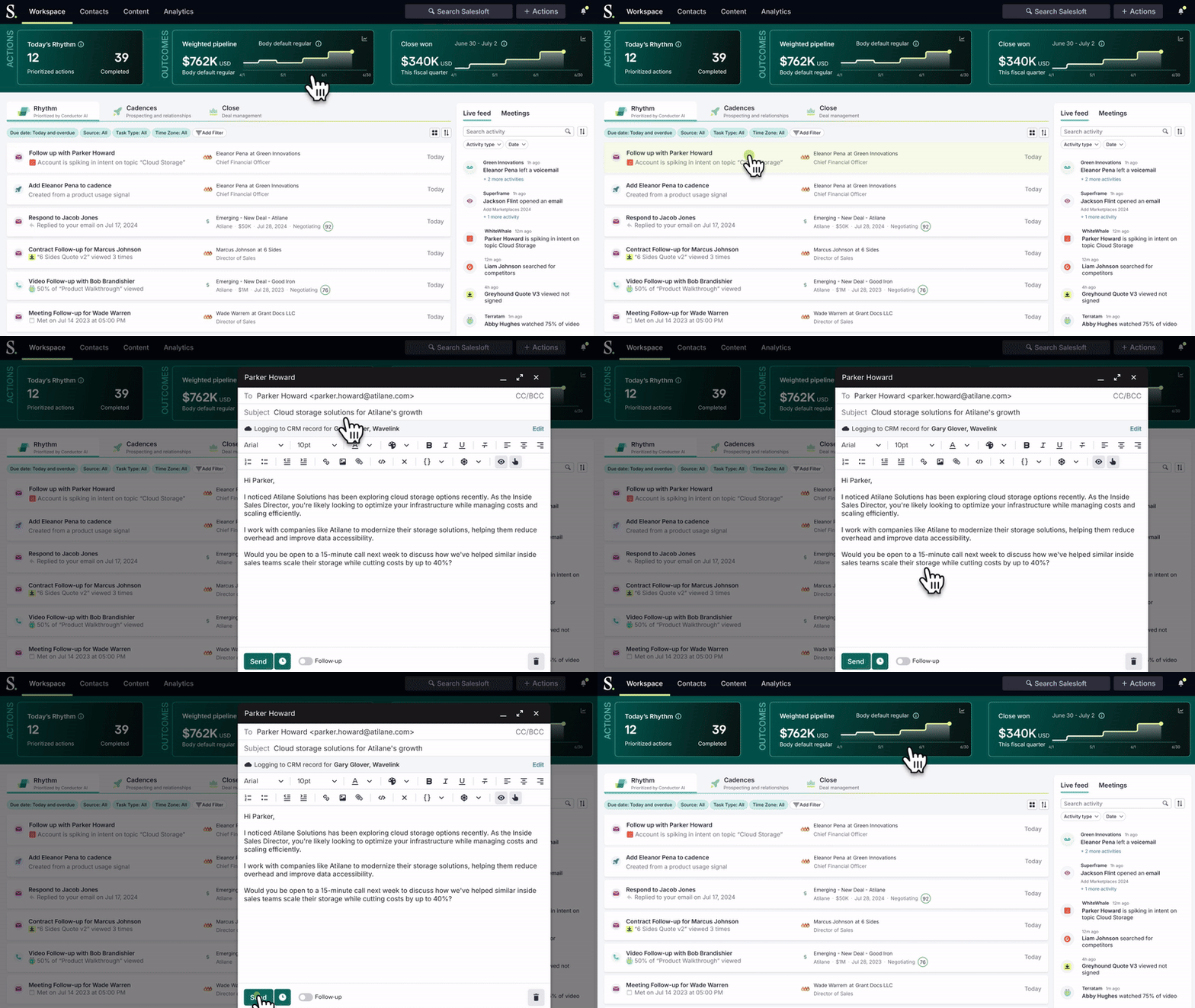
You're an AE carrying a midmarket book. Tuesday morning, Rhythm surfaces a priority action: a target account visited your pricing page twice in 48 hours, 6sense flagged them for active category research, and your champion opened three nurture emails last week but went quiet.
Rhythm ranks this as your top action and suggests a personalized follow-up on ROI and implementation timeline. You customize two sentences, hit send, and book a Thursday call. Total time: four minutes. Without Rhythm, that signal pattern might have surfaced across three dashboards on three different days, or not at all.
Stop detecting. Start acting on signals.
Signals only create revenue outcomes when they trigger consistent, timely action. Detection without orchestration is a reporting exercise. Salesloft's Predictive Revenue System closes the gap between signal and seller response by connecting Cadence, Rhythm, Deals, Analytics, and Conversations into a single signal-to-action model. Every signal your buyers generate, such as behavioral, firmographic, first-party, or deal-level, feeds into a system that tells your reps what to do next, automatically.
If your team is already collecting signals but struggling to act on them consistently, that's the gap Salesloft is built to close.
Schedule a 15-minute chat with us so we can help your team start acting on buyer signals.
Want to keep the learning going?
Check out these other resources on B2B buying signals:
- The Rise of the Buying Signal Economy
- How Salesloft Delivers More Value from Your CRM
- Your Guide to B2B Buying Signals: What They Are & How to Use Them