



What Is a Sales Funnel? Build, Measure, and Run One
Updated:
Published:



You're in a Monday pipeline review. The numbers look healthy on paper, deals are in late stage, but then the quarter ends and you miss your number by 20%. The deals were there. They just weren't real.
That's not a pipeline problem, but a funnel problem. And the difference matters.
A sales funnel isn't a marketing diagram. It's a diagnostic system. It tells you where buyers are accelerating, where they're stalling, and whether the deals your team is counting on will actually close. This blog covers what a sales funnel is, how to build one with real exit criteria, which metrics reveal where revenue is leaking, and how to connect funnel health to forecast accuracy.
Key takeaways
- A sales funnel tracks how buyers move from awareness to decision, but its real value is as an execution system that shows you exactly where pipeline is leaking and why deals stall before they close.
- Your funnel and your pipeline are not the same thing: the funnel measures buyer progression and conversion rates, while the pipeline tracks opportunity value and close dates. Reconciling both is what makes your forecast reliable.
- Every funnel stage needs defined exit criteria, not just a label. Without them, reps inflate stages, managers lose visibility, and forecast calls become guesswork.
- Four metrics tell you where revenue is leaking: stage-to-stage conversion rate, pipeline velocity, average deal cycle length, and win rate. Each one should trigger a specific action, not just a report.
- Funnel health is a leading indicator of forecast accuracy. When stage conversion rates drop or deals age past cycle benchmarks, your commit number is already at risk before the quarter ends.
What is a sales funnel?
A sales funnel maps how buyers move from first awareness of a problem to a purchase decision. For revenue teams, it's also a management tool that shows where that movement is accelerating or stalling.
In B2B, funnel movement is rarely linear. Buying groups, multiple stakeholders, and extended evaluation cycles mean progression requires active management — not passive tracking. If you're not inspecting the funnel, you're not managing it.
Sales funnel vs. sales pipeline
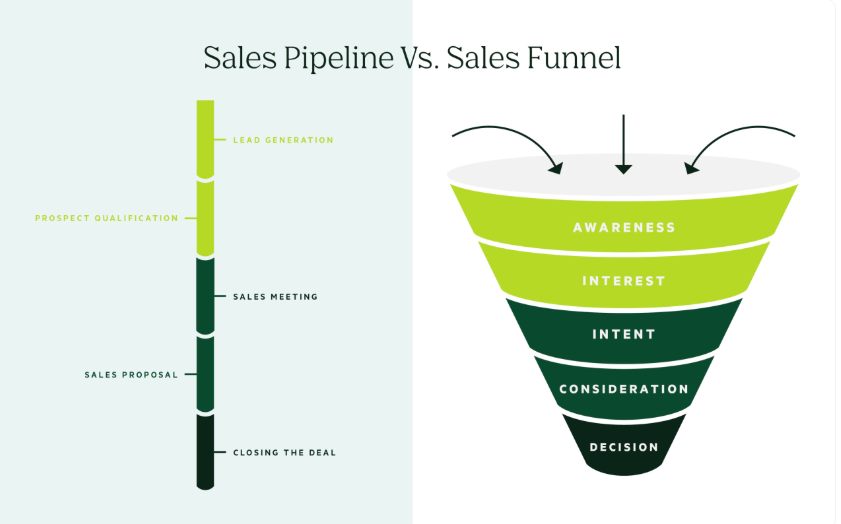
The funnel is the buyer's journey. The pipeline is the seller's view of opportunities in motion.
Your funnel measures conversion rates and stage progression. Your pipeline tracks deal values, close dates, and rep-owned opportunities mapped to CRM stages.
Both matter, but they have to reconcile. If your pipeline shows $2M in late-stage deals but your funnel shows a 30% drop-off at evaluation, your commit number is already suspect. Defining shared stage definitions that make the funnel and pipeline speak the same language is a RevOps responsibility. Without it, rollups are unreliable and inspection is theater.
The three stages of a B2B sales funnel
Top of funnel: generate qualified interest
TOFU is where buyers first recognize a problem and your team creates awareness through outbound prospecting, inbound content, and referrals. The pipeline outcome: TOFU health determines how much qualified pipeline enters the funnel. If TOFU thins out, you feel it later, based on your average sales cycle length.
What to inspect:
- Define ICP criteria before a lead enters the funnel so SDRs qualify in or out at first contact, not after three meetings
- Run multi-channel prospecting cadences using consistent follow-up across every rep
- Set a TOFU-to-MOFU conversion target and review it weekly. If it drops, diagnose whether the problem is lead quality, messaging, or follow-up speed
Middle of funnel: qualify hard, advance fast
MOFU is where marketing-qualified leads become sales-qualified opportunities, and where most B2B funnels leak. Deals that skip proper qualification inflate pipeline and distort your commit.
Apply a consistent qualification framework. MEDDPICC is the standard for complex B2B deals: Metrics, Economic Buyer, Decision Criteria, Decision Process, Pain, Champion, and Competition, all confirmed before advancing any deal.
Define explicit exit criteria that must be buyer-confirmed: a confirmed economic buyer, a documented pain statement, and an agreed next step at minimum. Map the buying group early. In enterprise deals, a single champion isn't enough.
Bottom of funnel: close With conviction
BOFU is where qualified opportunities move through evaluation, negotiation, and decision. Slippage here isn't a pipeline problem — it's a forecast miss.
Require a mutual action plan for every late-stage deal: agreed milestones, named stakeholders, and a decision date both sides have confirmed. Inspect weekly for deals with no recent activity, missing next steps, or stalled stakeholder engagement. Confirm all MEDDPICC elements are complete before calling a deal "commit." Incomplete qualification at BOFU is the leading cause of deals falling through in the late stage.
How to build a sales funnel your revenue team can actually run
Most teams have a funnel in theory but not in practice. Stage names exist in the CRM, but no one agrees on what they mean or what must be true before a deal advances. Fix that with these five-steps:
- Define stage names and exit criteria (RevOps). Write down exactly what must be confirmed, by the buyer, not just the rep, before a deal advances. Vague stages produce inflated pipelines.
- Map stages to CRM fields (RevOps). Every exit criterion needs a corresponding CRM field reps update. If it's not in the CRM, it doesn't exist for inspection or forecasting.
- Assign handoff SLAs between SDR and AE (Sales Manager). Define the maximum time between a qualified lead and an AE first touch. Slow handoffs are one of the most common TOFU-to-MOFU conversion killers.
- Set an inspection cadence (Sales Manager). Weekly pipeline reviews and bi-weekly 1:1s are the minimum. Review stage aging, exit criteria completion, and next-step quality — not just deal counts and amounts.
- Build a feedback loop between funnel stages and forecast (RevOps + Sales Leadership). Review stage conversion rates monthly. When a rate drops, investigate root cause before it becomes a forecast miss.
For more on building a stronger pipeline, the principles that apply there apply here too: structure enables execution.
Sales funnel metrics that tell you where revenue is leaking
Tracking stages isn't enough. You need to measure how efficiently buyers move through each stage, and act on what the numbers tell you.
Stage-to-stage conversion rate. The percentage of deals that advance from one stage to the next. If conversion drops at a specific stage, that stage has a qualification, messaging, or process problem. Investigate before the next pipeline review.
Pipeline velocity. How fast deals move through your funnel, measured in revenue per day: (number of opportunities × average deal value × win rate) ÷ average sales cycle length. Declining velocity is an early warning of forecast risk.
Average deal cycle length. The average number of days from opportunity creation to close, tracked by segment, rep, and deal size. Deals aging significantly past your benchmark are stalled — flag them for coaching or disqualification, not optimism.
Win rate. Track win rate by stage entry point, not just overall. A high TOFU-to-MOFU conversion rate paired with a low BOFU win rate signals a qualification problem, not a closing problem.
Reviewed together, these four metrics tell you whether your forecast is grounded in reality or built on pipeline inflation. Sales automation can help surface these signals faster, but metrics only matter if they trigger action.
Common sales funnel mistakes (and how to fix them)
Most funnel problems are process problems that show up as pipeline problems.
Skipping qualification at MOFU. Reps advance deals to protect their pipeline numbers. Fix: enforce MEDDPICC exit criteria as a hard gate. If the economic buyer isn't confirmed, the deal doesn't advance.
Slow follow-up after TOFU conversion. A lead books a meeting and waits days for an AE response. Fix: set a maximum SLA for SDR-to-AE handoff (same business day for inbound) and track compliance in pipeline reviews.
Stage inflation that distorts forecasts. Deals sit in late stages for weeks past their expected close date with no activity. Fix: add a "last activity date" field to your CRM stage view and flag any deal with no activity in 14 days as at-risk.
Single-threaded deals in multi-stakeholder accounts. The AE has one champion but no visibility into the broader buying committee. Fix: require buying group mapping as a MOFU exit criterion. If you can't name the economic buyer and at least one other stakeholder, the deal isn't qualified.
Your funnel is a forecast system
The way your funnel converts is a leading indicator of whether you'll hit your number.
If your MOFU-to-BOFU conversion rate drops in a given month, your late-stage pipeline three months from now is already thinner than your current forecast assumes even if your pipeline count looks healthy today. You need to see that signal now, not at the end of the quarter.
Forecast calls built on CRM stage labels without underlying conversion data are guesses. Forecast calls built on stage conversion rates, deal aging, and activity signals are defensible.
What that requires: shared funnel stage definitions, consistent CRM data capture, and a weekly review rhythm that connects funnel health to the forecast number, not just pipeline counts.
How Salesloft helps you run a predictable sales funnel
Salesloft is the Predictive Revenue System, connecting AI agents to comprehensive revenue data so teams can fill the funnel faster, win more deals, and drive predictable outcomes. Here's how each capability maps to the funnel problems above.
Funnel leaks and rep prioritization
Salesloft Rhythm unifies buyer signals such as engagement data, deal activity, and conversation insights, into prioritized daily actions for AEs and SDRs. The Prioritizer and Priority Accounts Agent surface which accounts need attention today so reps focus on opportunities most likely to advance.
Stage-exit validation and coaching
Salesloft Conversations records, transcribes, and analyzes every buyer call. Conversation Summaries, Key Moments, and Action Items give managers an accurate view of what was actually discussed, not just what the rep logged. The AI Scorecard lets managers coach against consistent criteria and scale winning behaviors across the team.
Buying group coverage and deal health
Salesloft Deals gives AEs and managers a centralized deal workspace with AI-generated risk signals, stalled deal alerts, and Auto Buying Group Capture that automatically identifies and tracks stakeholders across complex accounts. Sales Methodology Extraction pulls MEDDPICC-relevant insights directly from call data so qualification gaps surface in workflow, not in a lost-deal review.
Operationalizing funnel metrics
Salesloft Analytics gives revenue teams a real-time view of pipeline health, engagement effectiveness, and stage conversion. The Analytics Interpreter Agent scans in-flight deals, surfaces risks and opportunities, and triggers recommended actions in Salesloft Rhythm so insights move into execution, not into a dashboard no one checks.
Start treating your funnel like the forecast system it is
A funnel that isn't actively managed is just a list of deals you're hoping will close.
The teams that call their number with confidence share three things: defined exit criteria, consistent inspection cadences, and metrics that trigger action rather than just fill a dashboard. If the gap between your current funnel and that operating model feels wide, that's what the demo is for.
Ready to fill your sales funnel?
Grab 15 Minutes With Sales.
FAQs
What's the difference between a sales funnel and a sales pipeline?
The sales funnel tracks buyer progression and stage conversion — how efficiently buyers move from awareness to decision. The sales pipeline tracks the seller's view: individual opportunities, deal values, close dates, and CRM stages. In a forecast call, you need both: pipeline volume tells you what's possible, and funnel conversion rates combined with stage aging tell you how much of it is likely to close.
How many stages should a B2B sales funnel have?
Use the number of stages your team can define with clear, buyer-verified exit criteria and consistently inspect. For most B2B organizations, three to five stages is workable, but what matters more than the count is that every stage has a specific definition, exit criteria the buyer must meet before advancing, and a corresponding CRM field your reps actually update. Clarity beats complexity.
What are the most important sales funnel metrics to track?
Four metrics give you the clearest picture of funnel health: stage-to-stage conversion rate, pipeline velocity, average deal cycle length, and win rate. The key is knowing what action each one triggers. A drop in MOFU conversion rate is a qualification problem. Deals aging past cycle benchmarks need coaching or disqualification. Win rate variance by rep is a coaching signal. Metrics without action triggers are just reports.
Why do sales funnels fail?
Most failures trace back to four operational problems: reps advancing deals without completing qualification (which inflates pipeline and distorts forecasts), slow SDR-to-AE handoffs that let warm leads go cold, stage labels in the CRM that no one agrees on, and single-threaded deals where the AE has one contact but no visibility into the broader buying committee. Each is fixable — but only if RevOps and sales leadership hold the standard consistently.
How does a sales funnel connect to sales forecasting?
Your funnel conversion rates are leading indicators of your forecast. If your MOFU-to-BOFU conversion rate drops in a given month, your late-stage pipeline three months from now is already thinner than your current forecast assumes, even if your pipeline count looks healthy today. Teams that call their number with confidence review funnel conversion and deal aging weekly, not just total pipeline value. The funnel isn't a separate system from the forecast, it's the data layer underneath it.