






Salesloft platform data from 40,000 sellers over 12 weeks shows a consistent pattern:
Sellers who use the platform most actively create 4 times more opportunities and book 8 times more meetings as those who use it least.
The relationship between Salesloft use and seller outcomes holds across roles, market segments, and account sizes. The same pattern appears when sellers are grouped by how consistently and broadly they use the platform, including its AI capabilities.
The findings point to a broader business issue. Organizations realize more value from Salesloft when sellers make the platform a consistent and meaningful part of how they work.
The most active users create more pipeline and meetings
Sellers were ranked by their total platform activity, including every email, call, and outbound step logged during the measurement period.
We compared the opportunities, meetings, and positive outcomes recorded by the top and bottom 10% of users. The study uses three outcome measures:
- Opportunities: New deals entered into the CRM, representing active pipeline rather than closed revenue
- Meetings booked: Confirmed calendar meetings with prospects scheduled through Salesloft
- Positive outcomes: Seller-recorded signals of progress, including favorable replies, accepted meetings, and forward movement.
The comparison revealed substantial differences across all three measures.
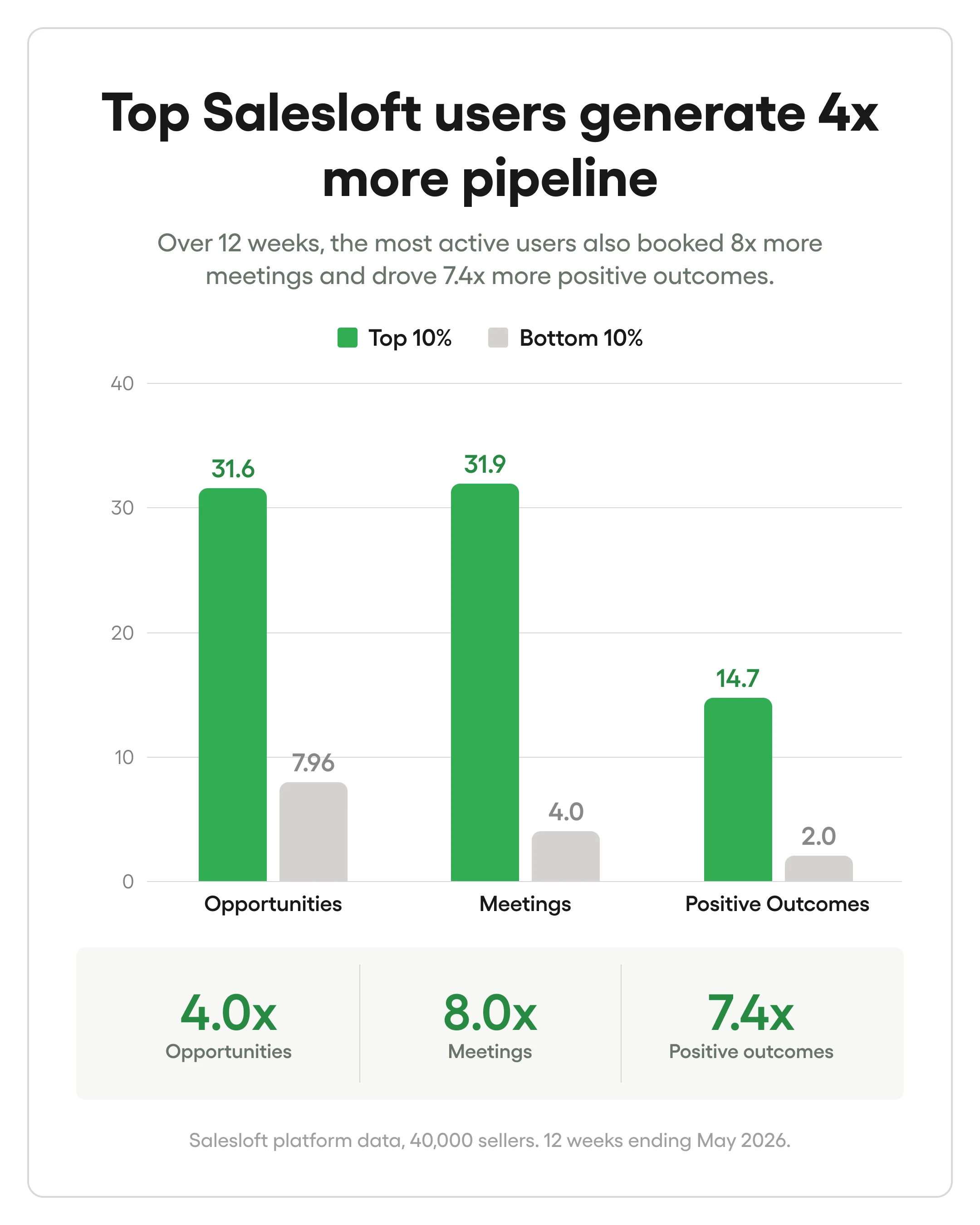
Approximately 4,000 sellers are represented in each group. Over the 12-week period, top users created about 24 more opportunities and booked nearly 28 more meetings per seller than bottom users.
The gap remained visible across every role, market segment, and account size included in the analysis. To determine whether high-volume prospecting teams were influencing the overall result, we compared sellers only with others in similar roles.
The advantage holds across seller roles
Activity quartiles were calculated separately within each role. Full-cycle Sellers were compared with other Full-cycle Sellers, while prospecting/sales development representatives were compared with their peers.
In every group, sellers with higher Salesloft activity created more opportunities than those with lower activity.
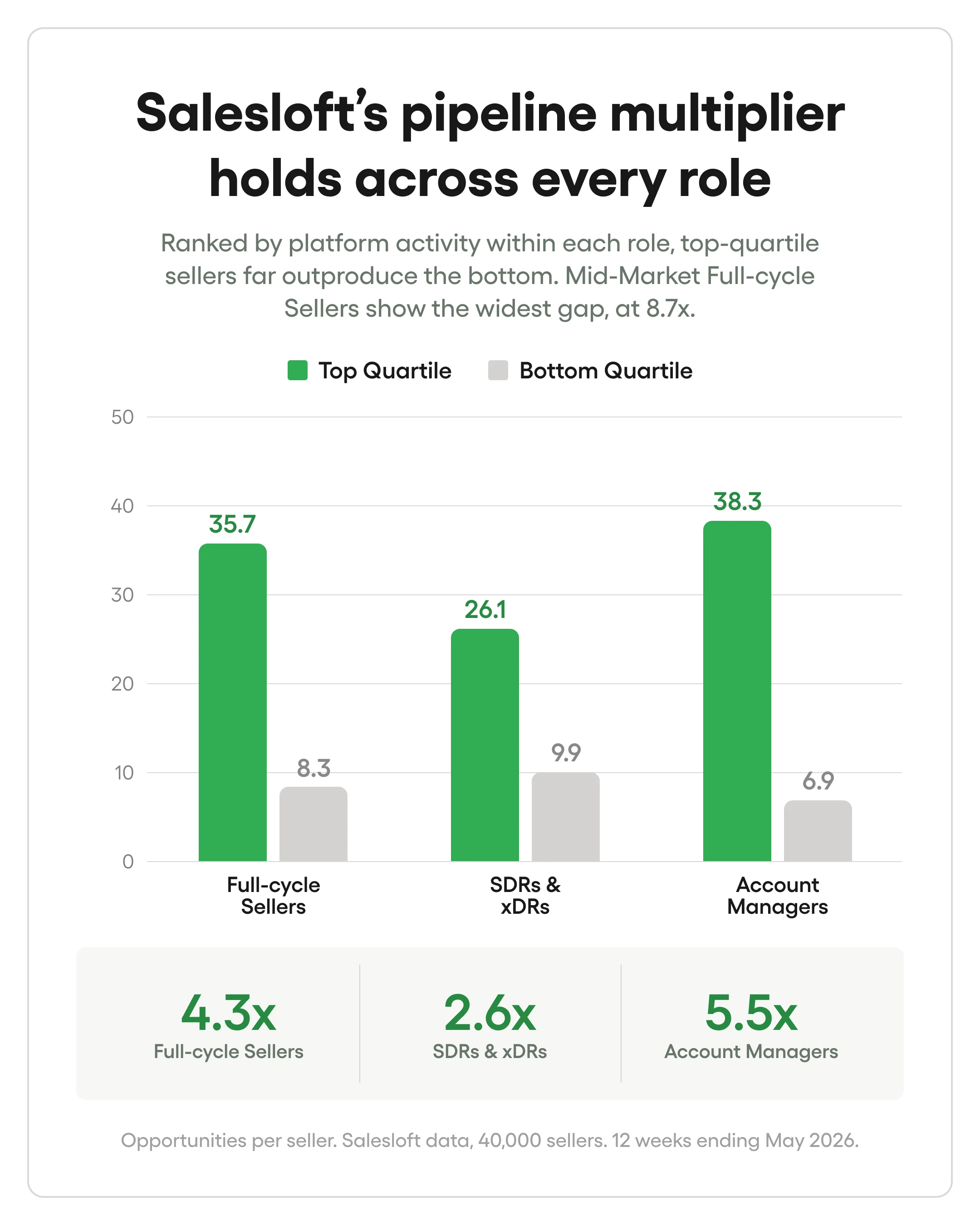
Account Managers recorded the widest gap, with top-quartile users creating 5.5 times as many opportunities as bottom-quartile users. Full-cycle Sellers followed at 4.3 times, while top-quartile SDRs/xDRs created 2.6 times as many opportunities as those in the bottom quartile.
The strongest result appeared among Full-cycle Sellers at Mid-Market organizations. The most active Full-cycle Sellers created 8.7 times more pipeline, recording 62.9 opportunities compared with 7.2. This was the largest multiplier for any role and market segment in the dataset.
The role analysis shows that the overall result was not concentrated among prospecting teams. The same pattern appears in how consistently sellers use Salesloft from week to week.
Consistent users produce stronger outcomes
Total activity captures how much work sellers complete, but not whether that activity is sustained. To examine consistency, sellers were grouped by the number of weeks in which they used Salesloft.
This comparison separated sellers who worked in the platform throughout the measurement period from those whose activity was concentrated in fewer weeks.
Sporadic users averaged 141 activities during the weeks in which they were active, compared with 258 among sellers who used Salesloft every week. That represents a 1.8 times difference in activity per active week.
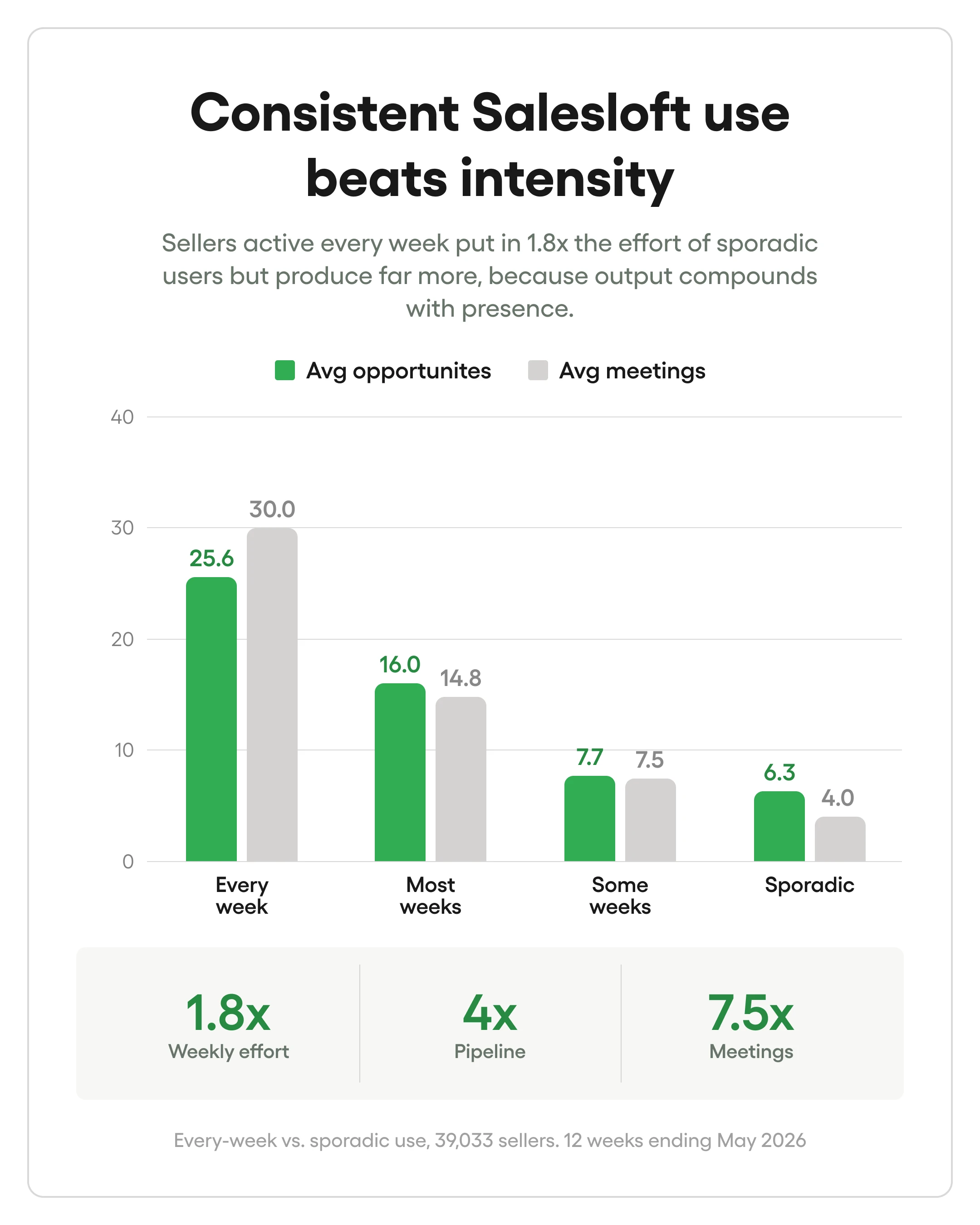
The difference in outcomes over the full measurement period was considerably larger. Consistent users created 4 times more opportunities and booked 7.5 times more meetings as sporadic users.
63% of sellers used Salesloft during 11 or 12 of the 12 weeks. The 9% who used it sporadically still completed a meaningful amount of work when active, but recorded far fewer opportunities and meetings.
The findings underscore the value of making Salesloft part of the weekly operating rhythm. Adoption also varies in breadth, based on how much of the platform sellers use once they are working inside it.
Sellers who use more products engage more deeply
We also measured adoption breadth by counting the number of distinct Salesloft products each seller actively used during a given week. The platform includes AI agents, cadences, conversation intelligence, deal management, analytics, and other capabilities.
We found that the average weekly interactions rose steadily as sellers used more products.
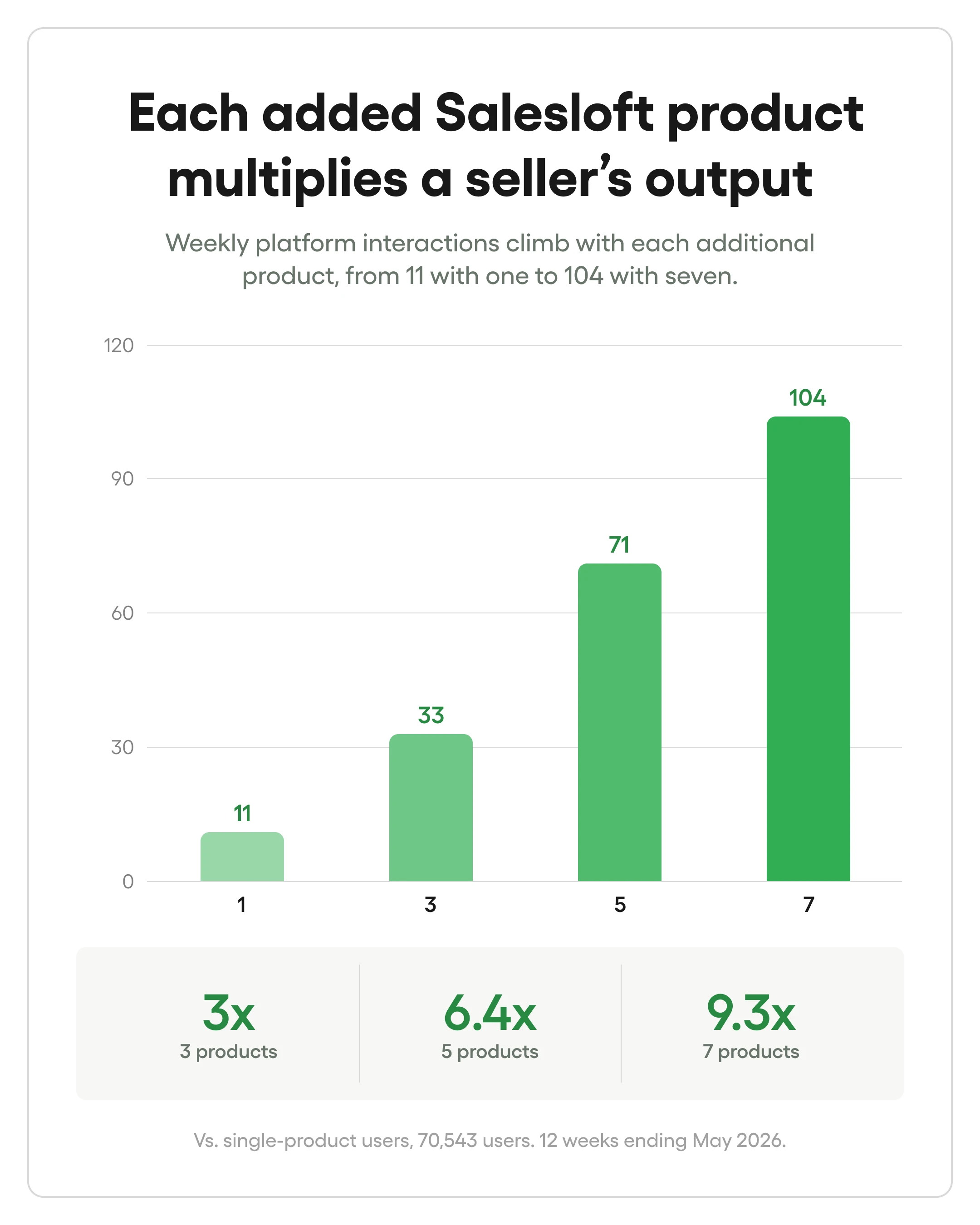
This analysis included 70,543 active users. More than half, or 51.5%, used three or more products.
Sellers using seven products averaged 104 platform interactions per week, compared with 11 among single-product users. Broader adoption places more of the seller's work inside Salesloft, connecting more capabilities in the same workflow.
This portion of the study measures platform engagement rather than pipeline directly. Across the broader analysis, however, higher engagement was associated with more opportunities and meetings.
And the same pattern appears among sellers using Salesloft's AI capabilities.
AI users work at higher volume
Salesloft's Person Research, Account Research, and Buyer Identification AI agents provide synthesized information about prospects and accounts before sellers make calls or draft emails.
Person Research had the broadest adoption, with approximately 10,000 active sellers, making it the focus of this comparison. Their average weekly activity was compared with that of non-users over the same 12-week period.
Person Research users recorded higher activity across every measure included in the analysis.
They made nearly three times as many calls, completed 69% more outbound activities, sent 34% more emails, and booked 24% more meetings.
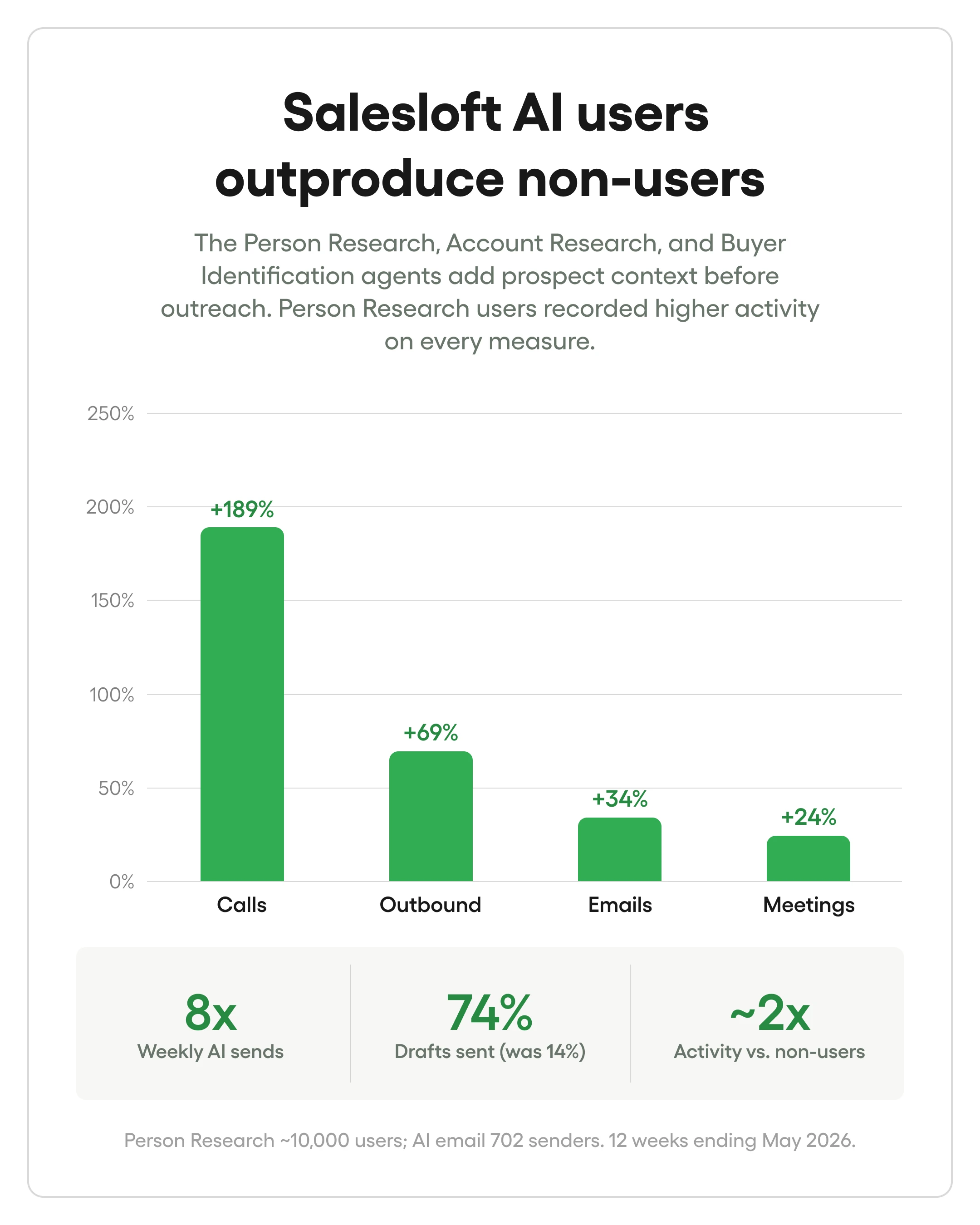
Use of AI-generated email showed a similar pattern. Weekly sends increased eightfold during the measurement period, rising from 923 to more than 7,500.
The share of AI-composed drafts that sellers chose to send also rose from 14% to 74%. By the end of the period, sellers were sending nearly three-quarters of the AI-generated drafts they created.
The 702 active users of AI-generated email averaged 369 total activities per week, compared with 188 among non-users. They also made 153% more calls and sent 64% more emails.
The AI usage findings reinforce the broader pattern across the study: sellers who incorporate more of Salesloft into their regular workflow record higher levels of activity and stronger outcomes.
Underuse carries a measurable cost
Across the analysis, a clear divide emerges between sellers who make Salesloft part of their regular workflow and those who barely use it.
Bottom-decile users averaged 38 outbound activities across 12 weeks, or roughly three per week. They created about eight opportunities and booked four meetings. Top-decile users created about 32 opportunities and booked nearly 32 meetings during the same period.
For teams that already own Salesloft, limited adoption can mean fewer conversations, fewer meetings, and less pipeline.
The findings also carry implications for teams operating without Salesloft. Their sellers may be working without structured workflows, multichannel cadences, prospect research, and unified revenue context.
The analysis cannot predict the exact improvement an individual team would see after adopting the platform, but it shows the size of the gap between limited and sustained use.
That difference becomes substantial at scale. The gap of roughly 24 opportunities per seller over the 12-week measurement period annualizes to approximately 100 opportunities.
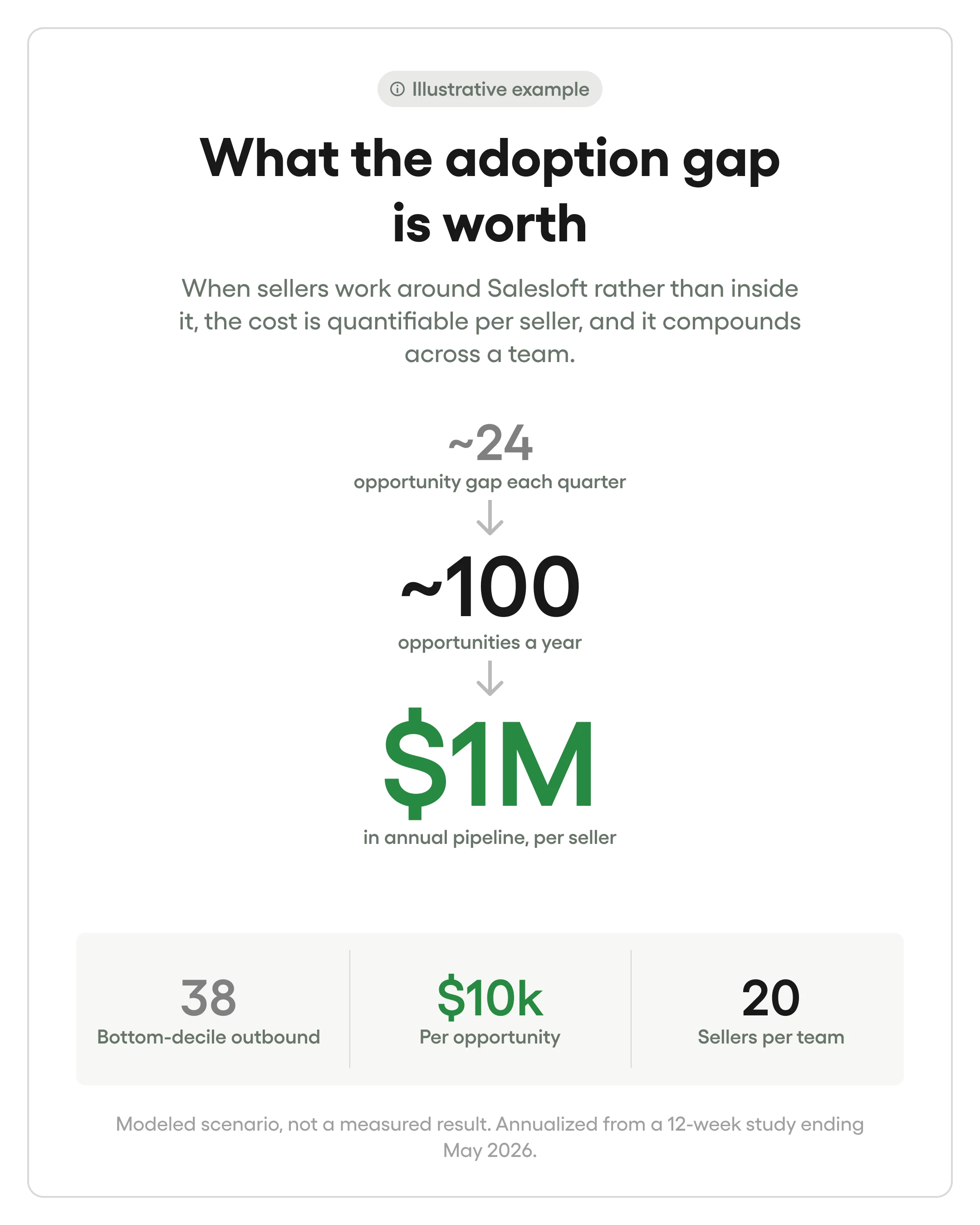
At a hypothetical average pipeline value of $10,000 per opportunity, that approaches $1 million in annual pipeline per seller. Across a team of 20, the potential impact extends well beyond software utilization.
Across roles, usage patterns, product breadth, and AI adoption, the same relationship appears: sellers who use Salesloft deeply and consistently generate far more pipeline and book far more meetings than those who use it least.
What does this mean for your sales team?
For current customers, a closer look at how sellers use Salesloft can help identify where adoption remains uneven and where more value may be available. Reach out to your Salesloft account team.
For teams evaluating Salesloft, the findings offer a useful benchmark for what deeper, more consistent use can support.
Talk to Our Sales TeamSource
Salesloft platform data from a 12-week period ending in May 2026. The analysis included 40,000 active sellers across thousands of customer accounts. Role-specific comparisons used percentiles, a minimum threshold of 10 activities, and active licenses only. The multi-product analysis included 70,543 users across 13 products. The AI agent analysis included approximately 10,000 Person Research users. The AI email analysis included 702 active senders. The consistency analysis included 39,033 sellers measured by weekly active presence. This observational analysis identifies associations between Salesloft use and seller outcomes and does not isolate causation.