




Your AI Isn't Underperforming. It's Underinformed.
Published:


The next advantage in revenue AI won't come from a better model. It'll come from what you feed it.
Most of the AI conversation in revenue right now is about the model. Which LLM is the smartest. Which one writes the best email. Which agent framework is next.
It's the wrong conversation.
Your reps open Claude, ChatGPT, Copilot, or Gemini every day. They draft emails, prep for calls, summarize notes. These are genuinely capable models. But they don't know which deal is stalling. They can't see which account went dark last week. They've never heard a single call your team has had with a buyer.
That's not a model problem. The models are remarkable. It's that we keep asking them to reason about a business they can't see. And that gap is expensive.
It’s a big reason why so much AI investment hasn't paid off the way the board expected. Last year, 87% of enterprises missed their revenue targets despite record spend on AI. Not because the technology fell short — because the context did.
The model was never the differentiator
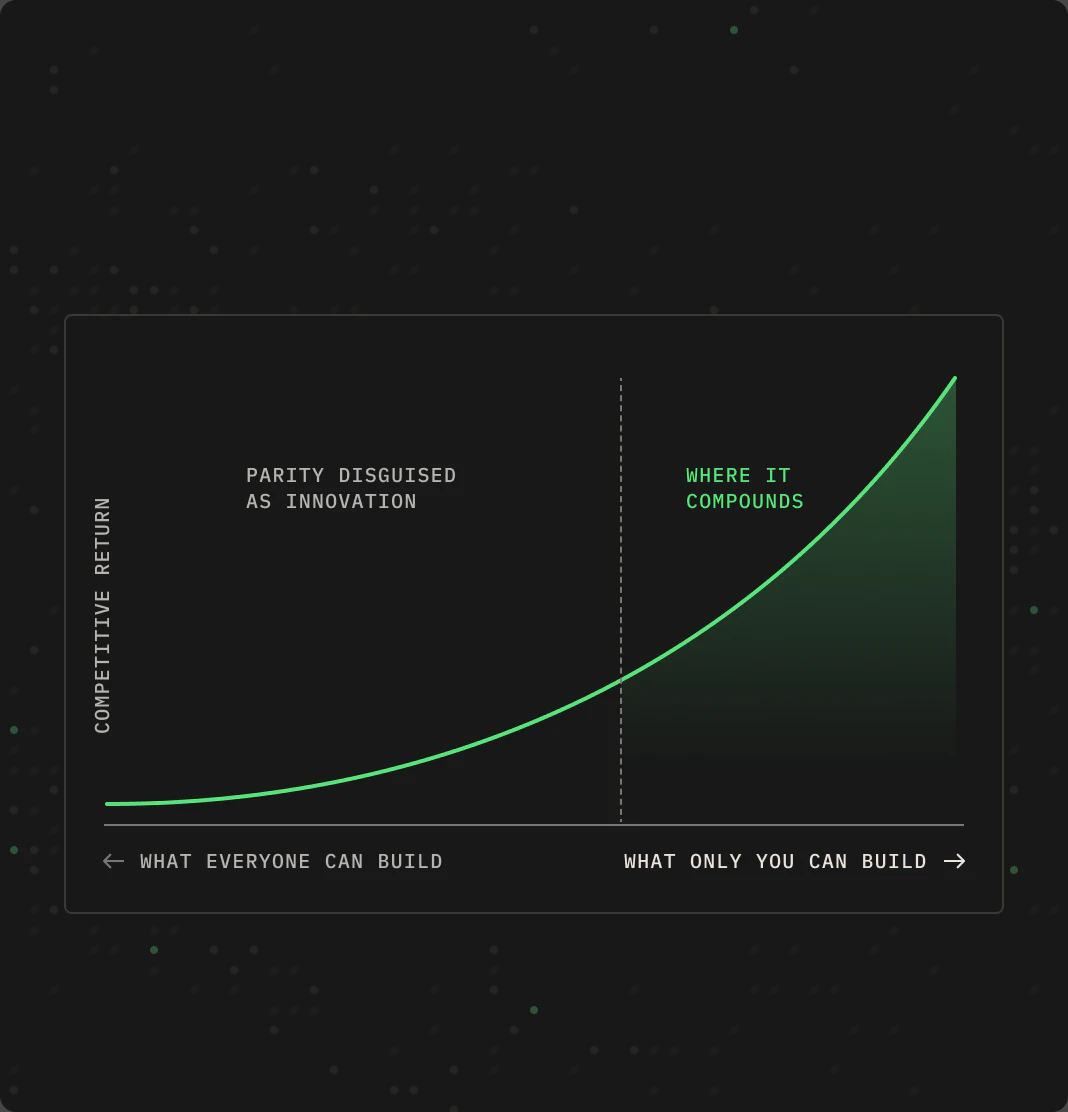
Here's the part the market is slow to admit: everyone has access to the same models. The same reasoning. The same frontier capabilities, available to you and every competitor on the same afternoon.
So the model can't be your edge. It's a commodity.
What separates the teams getting real value from AI from the ones still waiting is simple: what the AI knows about their business. That's the entire game now. And it's a different game than the one most teams are playing.
When teams realize their AI is flying blind, the instinct is to give it more data.
"Access to data" is not context
When teams realize their AI is flying blind, the instinct is to give it more data. Export the pipeline. Paste in the numbers. Wire up a feed.
But access isn't context. A pile of data the AI can technically reach is not the same as the right understanding at the right moment. Three things separate one from the other:
- It has to be complete. A transcript without the pipeline behind it is half a story. Pipeline numbers without the conversations that explain them are the other half. Feed AI a slice, and it reasons like it only knows a slice — because it does.
- It has to be fresh. AI reasoning over a CSV someone exported last Tuesday will give you a confident answer about a deal that already moved. Stale context doesn't produce caution. It produces wrong answers delivered with total certainty.
- It has to be connected. This is the one almost everyone misses. AI can reach almost anything now. The hard part isn't access, it's the relationships between the data. The insight lives in how a sentiment shift connects to a stalled deal connects to a missing stakeholder connects to a rep actually making that outreach connects to the forecast and final revenue outcome. Isolated facts don't get you there. The value was never in the data points. It's in how they're stitched together.
Most teams are feeding their AI context that's partial, stale, and the output can only reflect what it was given.
What MCP actually changes
The Model Context Protocol (MCP) gets talked about as a connector, a technical integration, a way to plug tools into data. That framing undersells it.
The real shift is in the question it lets you ask. For years the question was "what can the AI do?" MCP makes the better question possible: "what should the AI know? And how should it take action on what it knows?"
That's not a small reframe. It moves the constraint off the technology entirely. When your AI can finally reason over context that's complete, live, and connected, the limit stops being what the model is capable of — and becomes what your team is imaginative enough to build. That's a far more impactful problem to solve.
But it only works if the context underneath is real. Connect AI to a thin or fragmented data set, and you've given it an incomplete picture to reason from. Connect it to the full, living picture of your go-to-market revenue motion, and the output finally reflects your actual business, and enables you to take agentic action on it with confidence.
So the question worth sitting with isn't which AI should we use. It's what parts of our business are we feeding it — and is that context complete enough to trust?
Where the richest context already lives
For most revenue teams, that context already exists. It's just been locked inside the systems where the work happens — pipeline movement, call transcripts, engagement signals, deal history, the forecast itself.
This is the lens we built through. Clari + Salesloft sits on the most complete revenue context in the market that covers the entire revenue lifecycle: execution, conversations, and forecasting, from first touch to final forecast. That context is live, connected, and now open to whatever AI tools your team already uses. Not a slice. Not a snapshot. The whole revenue motion, in a single question.
Context is your advantage. The teams that internalize that first are the ones who will see the ROI on their AI first.
Want to see what your AI could do with the full picture? Chat with an expert.