






The Revenue Operations Framework for Predictable Revenue
Published:


Editor's note: This blog post was originally published by Clari prior to its merger with Salesloft. The content remains relevant, though some product details or references may have evolved. Learn more here.
Whether you're a large enterprise team with hundreds of sellers or a fast-growing organization with tens of sellers, one thing is clear: Revenue can no longer be viewed just as an outcome. It's a business process.
In fact, revenue is the most critical business process for any company and should be controlled, measured, and automated like any other process. While all revenue teams focus on doing whatever it takes to make the number every 90 days, many don't treat revenue as an end-to-end process that can be managed for efficiency and predictability.
In this era of remote selling, the ability to inspect your deals and accounts throughout the revenue process is even more critical to having confidence you're going to hit your number.
This is why we're sharing our Revenue Operations Framework.
Revenue operations, defined
Revenue operations (some may call it RevOps) is the end-to-end process of generating revenue by the entire revenue team. It is not just marketing operations, sales operations, and customer success operations combined into one team. It includes all the sellers and marketers and customer success professionals that are all working together to power the revenue engine and drive revenue results.
For a more in-depth primer on revenue operations, take a look at our story and infographic The Rise of Revenue Operations
Introducing: Salesloft's revenue operations framework
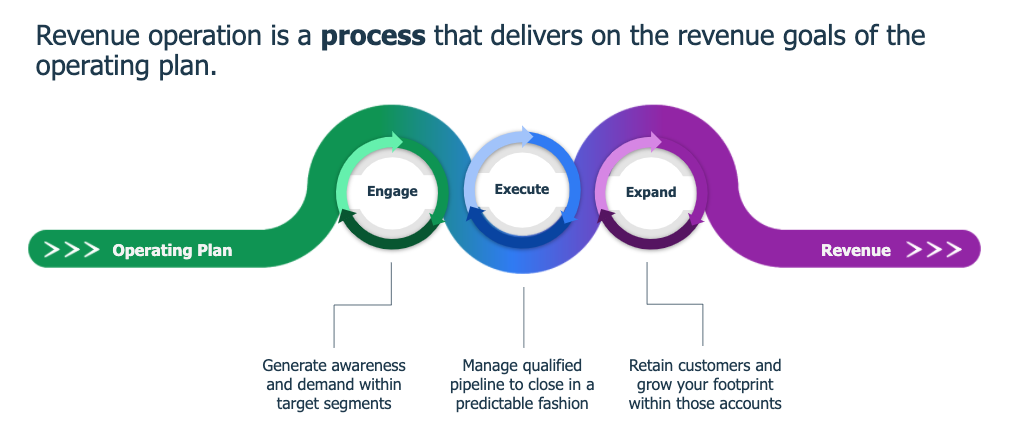
The revenue process starts with the operating plan, where revenue goals are set for the company. We've defined three main phases, which each have their own process:
Engage is the process of generating awareness and demand within your target segments and target accounts. In this phase you target the right accounts with marketing programs and campaigns, and your SDR team is actively prospecting into these accounts with the right messaging and offers to build the pipeline.
Execute means taking qualified pipeline and managing it to close in a predictable way. In this phase, you enable your field organization and continuously provide coaching and guidance to convert that pipeline to close.
Expand is the process of retaining and growing your footprint within your install base. In this phase, you manage renewals, cross-sell, and up-sell opportunities to drive customer retention.
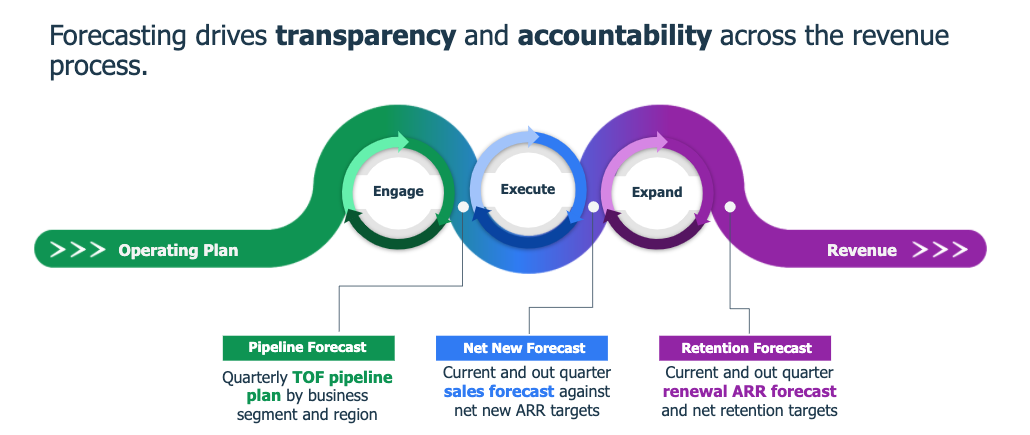
This will look different for every company, depending on your business model. The key to driving what we call full-funnel accountability across the entire revenue process is the forecast, which is the output of every stage in the revenue process and the heartbeat of revenue operations. The forecast at each stage represents the commitment of the team that's accountable for that stage.
- The growth team provides the quarterly TOF pipeline plan: How much pipeline they commit to deliver by segment, by team, and by region for the coming quarters.
- The sales team provides the current and out quarter sales forecast against net new ARR targets from the operating plan.
- The customer success team delivers the current and out quarter churn forecast against net retention targets. This also informs what changes needed on the net new business to hit revenue targets.
Below we'll dive into each of the three phases in our Revenue Operations Framework, covering inputs, processes, metrics, the tech stack, and KPIs.
Phase 1: engage
The first phase of the Revenue Operations Framework is mostly driven by growth marketing, demand generation, and SDR teams as the top of funnel motion with the main KPI of qualified pipeline.
In this way, all of the inputs, processes, metrics, and tech are aligned with the sole purpose of driving qualified pipeline. And it also dictates how the entire top of funnel team functions.
KPIs
- Qualified pipeline
Inputs
- Operating plan
- ICP definition
- Segmentation
Processes
- ABM
- Digital Ads
- SDR Outreach
Metrics
- Quarter-to-date pipeline created
- Quarter-to-date pipeline quality
- Next quarter coverage
- Pipeline acceleration
- Target account engagement
Tech stack
- Marketing automation
- Sales engagement
- Conversational marketing
- Data enrichment
- Revenue operations platform
When the entire revenue team can align on the key success metrics, they can spend their time driving meaningful impact instead of debating the data or clamoring for acknowledgement.
Phase 2: execute
The teams primarily responsible for the execute phase are field sales teams. They're the ones driving deal inspection and deal execution. Key to success in this phase are the operational cadences the entire revops team adheres to.
"Two keys to success in the execute phase are the GTM teams' ability to focus company capacity on the right segments, and the front line leaders ability to target their coaching on the right deals in those segments," says Anthony Cessario, VP of Enterprise Sales at Clari. "In this remote world, having the right instrumentation and revenue cadence in place to keep a pulse on these efforts is more critical than ever. Whether it's one-on-ones, forecast calls, QBPs (Quarterly business plans), out-quarter sales pipeline reviews, or your ABM checkpoints, ensuring all participants have a single and clear lens into the data allows us to focus our time on making the news and not on reporting it."
KPIs
- Net new ARR
Inputs
- Operating plan
- Pipeline plan
- Territories
- Quota
Processes
- One-on-ones
- Deal reviews
- Forecast calls
- Account reviews
- Pipeline reviews
- Quarterly Business Review
Metrics
- Net new ARR/average contract value
- Win rate
- Sales cycle time
- Average selling price
- Customer acquisition cost
- Forecast accuracy
- Slip rate
- Quota attainment
- Rep ramp time
Tech stack
- CRM
- Revenue operations platform
- Sales enablement
- Conversational intelligence
While the CRM is critical to business growth in this phase, it's not enough. A revenue operations platform like Salesloft gives you true visibility into each deal and account in the context of your most important revenue cadences so you can see what's going on in your business, have confidence in your number, and get a clear line of sight into how you're going to hit it.
Phase 3: expand
Customer retention is just as important as net new customers, especially for SaaS businesses running on subscription models. This phase, which is primarily led by the customer success and account management teams, holds equal weight as the previous two phases.
But just like every other phase, there is room for cross-functional collaboration across the entire customer journey.
When the entire revenue operations team comes together and aligns under the same goals, they can streamline the customer experience—instead of creating a siloed experience where the customer feels like they're tossed from team to team.
KPIs
- Renewal and expansion ARR
Inputs
- Operating plan
- Churn budget
- Renewal quotas
- NPS
- Account health
- Processes
- Renewals
- Churn forecasting
- Whitespace
Metrics
- Net dollar retention
- Churn/renewal rate
- Upsell/cross-sell ARR
- NPS
- Customer lifetime value
- Customer segmentation
Tech stack
- Customer success
- Product analytics
- Revenue operations platform
The team in charge of this phase may be structured slightly differently depending on your organization. At Salesloft, renewals and expansion are led by the account management team. Customer success is responsible for training, user adoption, and ensuring customers get the most out of our product.
Revenue operations pitfalls
Of course everything we've shared up until now sounds great: alignment, accountability, the ability to take action as a revenue team. But where do things tend to fall apart?
Marketing, sales, and customer success need complete and accurate information to drive campaigns, advance opportunities, and forecast the business.
Salesloft automatically captures rep activity and customer engagement data, and ingests data from tools like marketing automation, email, calendar, and sales engagement platforms, so revenue operations teams can have a full view of what is actually happening across every deal at all times. In fact, 78% of leaders report improvement in data quality since they began using Salesloft.
Interested in learning more about our Revenue Operations Platform? See Salesloft in action.