




How to Bring Evidence Into Your Sales Coaching
Published:


A rep is behind target. The deal that looked solid three weeks ago hasn’t moved. Their manager knows something is off, but figuring out what is the hard part.
The reasons are usually spread across calls, emails, meetings, CRM updates, and changes in buyer engagement. By the time a manager pieces it together, the coaching session becomes a recap of what went wrong, and the chance to change the outcome has already passed.
Salesloft’s 2026 Revenue Benchmark Report found that many managers struggle to pinpoint these deal-level hurdles. 89% of sales leaders believe their managers assess seller performance objectively, yet only about 32% can instantly diagnose why a deal has stalled. Further:
- 27% can see win/loss rates but can’t explain what happened between stages.
- 55% say their CRM data is mostly subjective seller reporting.
- 56% of managers coach every two weeks or more, which suggests managers are coaching often, just not with evidence.
Only ~32% of sales managers can instantly diagnose why a deal has stalled.
Those numbers suggest that many managers coach without hard evidence. Without data, coaching drifts toward gut feel, and gut feel doesn’t improve the rep’s or the business’s performance.
Fortunately, the signals behind performance already live in your calls, tools, and CRM. The key is surfacing them while there’s still time to act.
Coach to leading indicators, not stalled deals
Most coaching conversations start with the pipeline. Which deals moved, which ones slipped, and which ones have sat in the same stage for too long. Those numbers matter, but they only show what already happened. By the time a deal looks stuck on a dashboard, the moment to help the rep has often passed.
Paul Self, RVP at Salesloft, coaches with a different focus. He advises looking past where a deal sits today to the signals that show where it’s headed. “A pipeline review is like doing an autopsy,” he says. “A true coaching session with a rep is like a physical.”
“When I walk into a one-on-one with a rep, I want tangible points I can actually look at, review, and discuss,” Paul says. “These points help improve our discovery, improve our qualification, and add velocity to our deal cycles.”
Those points come from leading indicators, the behaviors that signal where a deal is headed before it moves stages. Paul highlights three that managers can observe and coach to:
- ROI validation: Has the buyer bought into the business case?
- Executive engagement: Is a decision-maker involved?
- Multi-threading: Is the rep building relationships with several stakeholders at the account?
These behaviors show up long before a deal changes stages. When managers coach to them early, they can help a rep fix a weak business case or bring in another stakeholder while the deal is still in play. But managers can only coach to what they can see, and that depends on how well the team captures what’s happening in each deal.
How to give managers the evidence they need for sales coaching
Deal dashboards show which pipeline was built, leaked, slipped, or pulled in. They don’t show the work between stages, which Paul calls the invisible steps.
Did the team prep well before the call? Did internal stakeholders know which topics to listen for? Did everyone debrief after a high-stakes demo? None of that shows up in a CRM, but it adds up.
These steps are where deals gain or lose momentum, and they’re also the easiest for a manager to miss, because they leave no trace in the pipeline. When managers can see the prep, the follow-up, and who on the team did what, they can coach to the habits behind a deal rather than only the result.
Here’s how Paul and his colleagues at Salesloft make those steps visible.
Everything lives in one place
Calls, emails, meetings, and CRM updates are captured and visible across the org, so reps and managers work from the same information. After a big call, the Salesloft team uses Rhythm to set up a task for each internal stakeholder. The task includes the call recording, transcript, summary, and next steps, plus the seller’s own notes on the goal for the next conversation.
Signals feed a deal health score
Key moments roll up into a score that managers and reps can review together during coaching. These include an executive joining the buying group, a prospect asking about pricing or implementation, or an account’s current state matching a won-deal pattern.
The same signals shape the forecast
Those deal signals also feed AI forecasts and the deal trends leaders use to run the business. That helps leaders answer the question Paul says matters most: “Can you point to the exact moment where the deal is changing?”
Pinpointing that moment gets easier when deal activity and the forecast are connected. That’s what a predictive revenue system does. It tracks what’s happening across the revenue process, acts on it, and learns from the results.
Every call, email, and meeting gets captured, and that activity shapes deal outcomes, like a meeting getting booked, a deal moving forward, or a close date slipping. Within a predictive revenue system, those outcomes update the forecast as they happen, so leaders can see where a deal is changing and why.
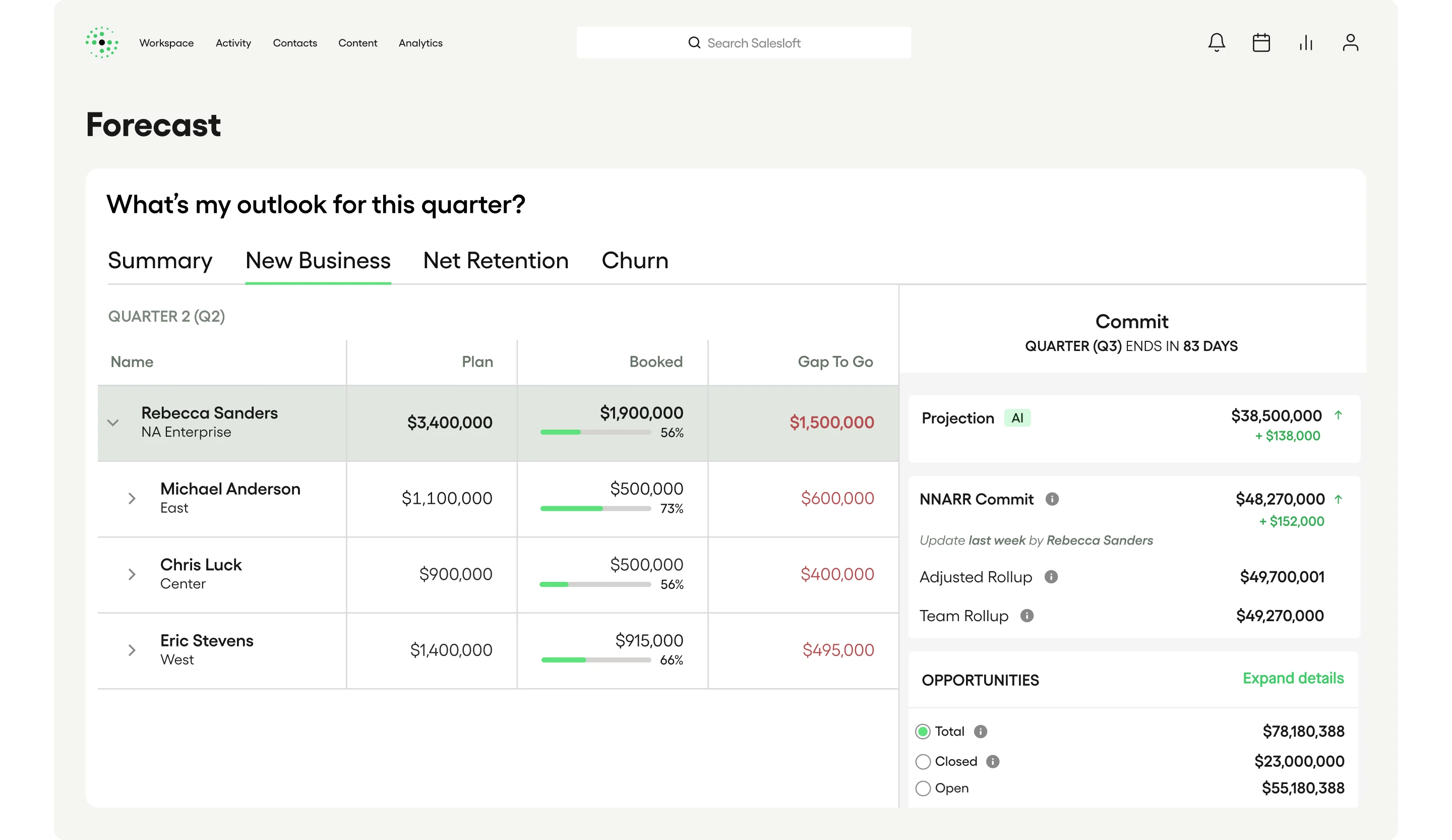
Integrate live rep and deal activity into coaching. This helps managers see which deals are at risk, create action plans, and keep reps on track.
Use data for sales rep development
Sales leaders like Paul split their one-on-ones between deal progression and rep development. Development is where coaching tends to get vague and where managers end up “coaching on vibes.” To keep it concrete, tie development to questions the data can answer. Is the rep prioritizing accounts with the highest propensity to buy? Do they know which personas and companies match the ICP? When a buyer raises an objection, does the rep dig deeper to find the root cause?
Reps want this kind of specific instruction. “I very rarely have seen a rep not ask for that type of guidance because that impacts their pocketbook directly,” Paul says.
Developing reps with data also pays off for the business. According to the report, the top 10% of sellers drive 47.4% of closed-won revenue. That means most of the team has room to grow, and even small gains across that group can move revenue. Paul sees more value in lifting the rest of the team than in adding headcount.
If I can get some of the B players on the team to B-plus players, that is more valuable than me having to go out and hire a new rep.
Sales coaching best practices: make evidence the foundation
For Paul, better coaching starts with the manager. “The emphasis should be on equipping managers to be effective coaches,” he says.
That means giving managers an evidence-backed view of every rep and every deal, so coaching doesn’t rest on judgment alone. Managers catch stalled deals sooner, forecasts get more accurate, and reps get feedback they can act on.
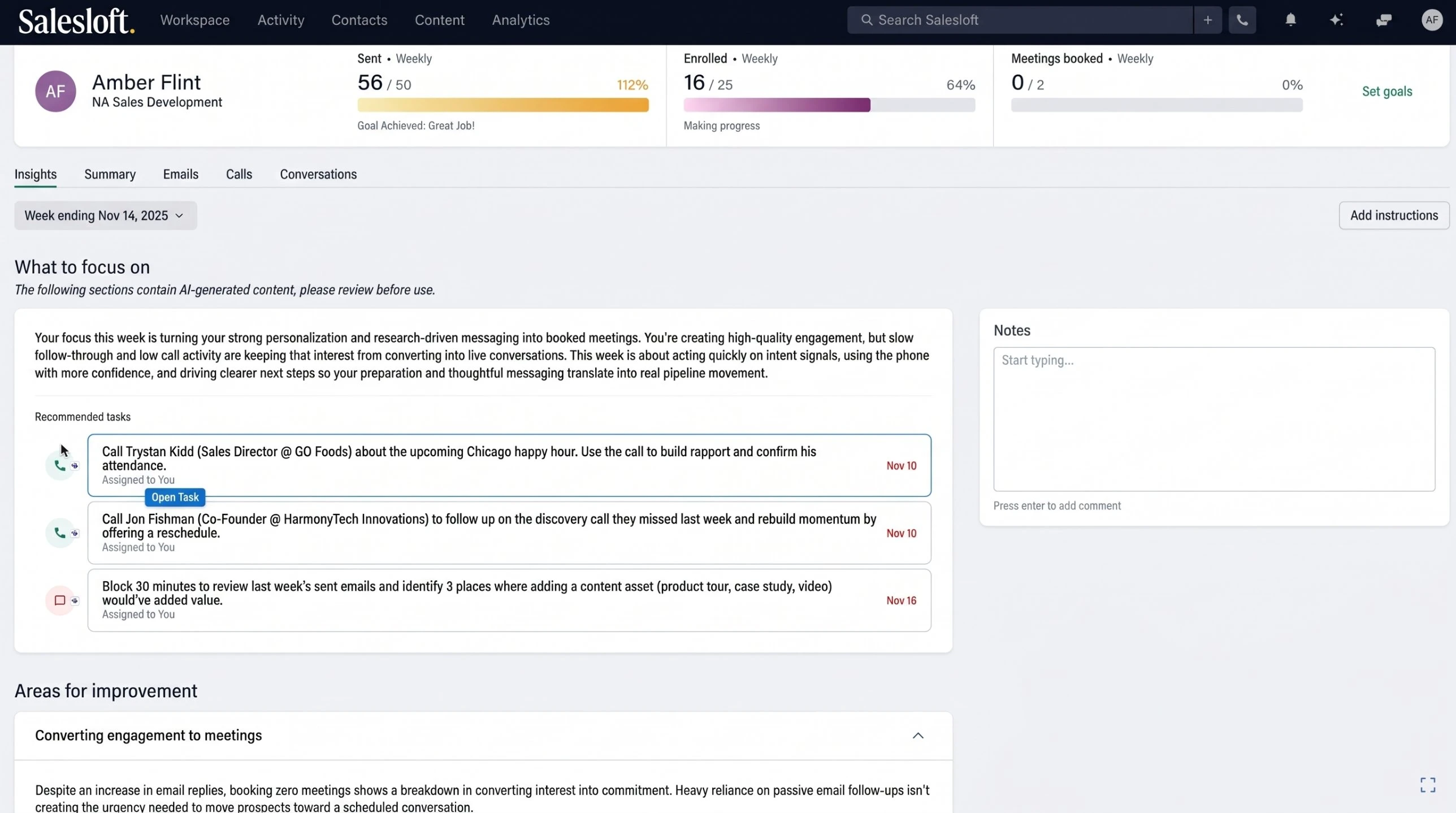
With Salesloft, managers can consistently run deal inspections and coaching sessions guided by the same structured process and data.
3 ways to coach sales reps with evidence in your next one-on-one
- Pick one deal and check its leading indicators. Look for proof of ROI validation, executive engagement, and multi-threading in the calls, emails, and meeting notes, not just the stage in your CRM. If one is missing, that’s your coaching conversation.
- Pull one piece of evidence for each point you plan to make. That could be a call snippet, an email thread, or a change in the deal health score. If you can’t point to something specific, ask the rep about it rather than drawing a conclusion yourself.
- Set aside time for development, separate from deal reviews. Choose one skill to focus on, like account prioritization or objection handling, and bring data that shows how the rep is doing on it. Then agree on one thing they’ll work on before you meet again.
Ready to bring more evidence into every coaching session? Read the sales coaching playbook.